



Tharu Art and Ornaments: The Culture Behind Our Tharu 4 Cushion Cover
by Shop Editor on 21/06/2022
Most people who visit Nepal’s Terai region think of it as a transit zone — a flat stretch you pass through on the way to the hills. What they miss is one of Nepal’s oldest living Tharu art and ornaments as well as cultures, right there under the open sky.
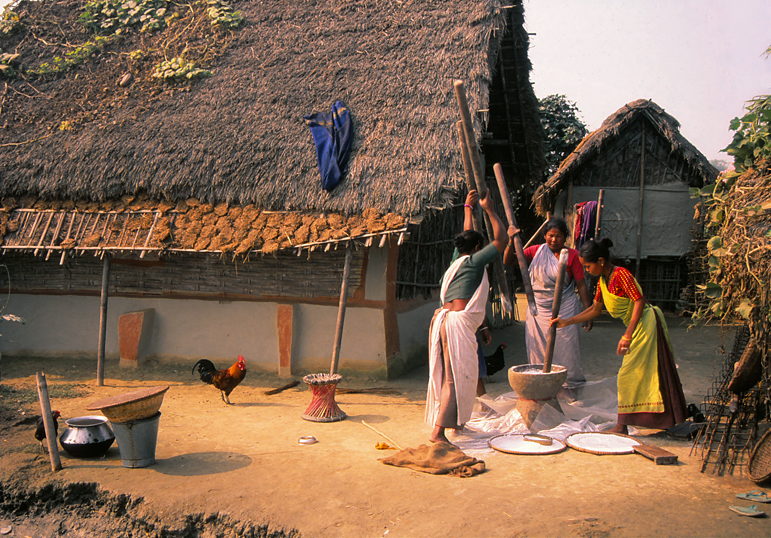
The Tharu people are the indigenous community of the Terai. They’ve been there for over a thousand years. Scholar Al-Biruni documented their presence in eastern Terai as far back as the 10th century. And in that long stretch of time, they built something genuinely distinct — in their art, in the ornaments they wear, and in the way they mark their own bodies.
This blog is about that culture. And about why it matters enough that Aja Dynasty built a cushion cover collection around it.
Who Are the Tharu People?
The Tharu are not one uniform group. They’re spread across the entire Terai belt — from Kanchanpur in the far west all the way to Morang and Sunsari in the east. Each region has its own subgroup: Rana Tharu and Kathariya Tharu in Kailali and Kanchanpur, Dangaura Tharu across western Terai districts like Dang, Bardia, and Rupandehi, Chitwan Tharu in the central belt, and Kochila and Danuwar Tharu in the east. Beyond Nepal, Tharu communities also live in adjacent parts of northern India.
Their origin stories are just as varied. Rana Tharus in western Nepal trace their roots to the Thar Desert of Rajasthan and consider themselves descendants of the Rajput family. Others claim descent from Gautama Buddha himself. What unites all these subgroups is something harder to pin down — a way of being in the world that shows up most clearly in their art, dress, and daily rituals.
Tharu Art and Ornaments: What It Looks Like and Why
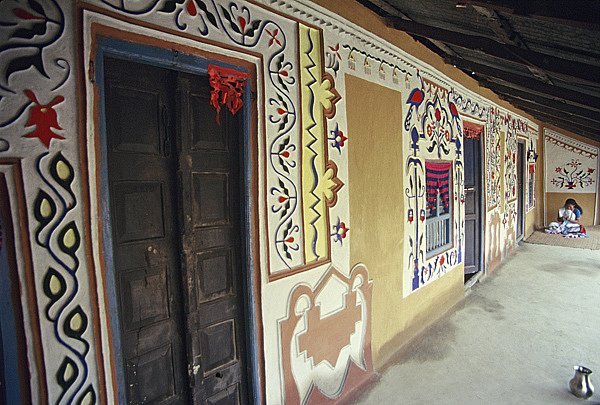
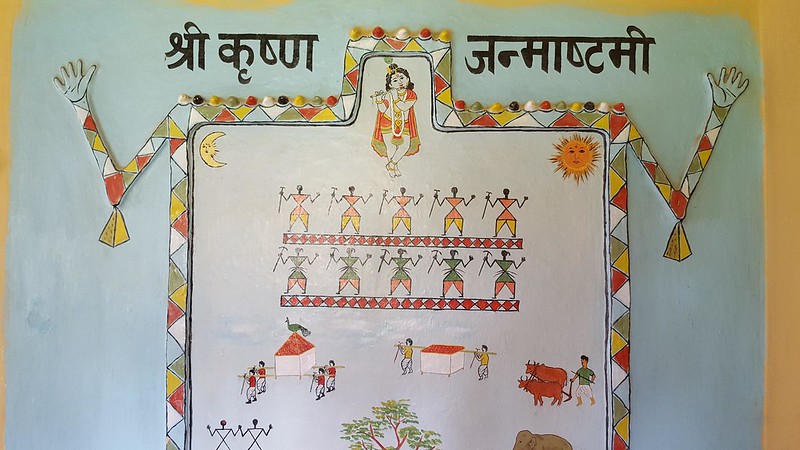
Walk into a traditional Tharu home and the walls tell you everything. Elephants, lions, horses, peacocks, fish, snakes, and flowering plants — painted directly onto the mud walls in a technique that resembles fresco painting. These aren’t decorations chosen for aesthetics. Each motif is tied to nature, belief, or community life.
Tharu women paint these walls themselves. They also decorate everyday household objects — Dhakiya, Machiya, Chhatari, Delawa, Moka, and others — turning functional items into something you’d stop to look at. On festivals like Astamika, Amausa, and Diwali, the paintings shift to include deities: Bhairava, Krishna, Rama, the Pandavas and Kauravas, and Astamatrika.
Beyond wall painting, Tharu arts include woodcarving and terracotta work. The Kuhara clan has a reputation for terracotta and pottery figurines. Tharu woodcarvers shape statues of Ganesha, Mahadeva, Brahma, and Vishnu, and carve their doors, windows, and household tools from the Saal tree.
What makes Tharu art distinct from other Nepali folk traditions is its closeness to the natural world. There are no abstract decorative fillers. Every elephant, every snake, every flower is there because it belongs.
Tharu Ornaments: A Head-to-Toe Tradition
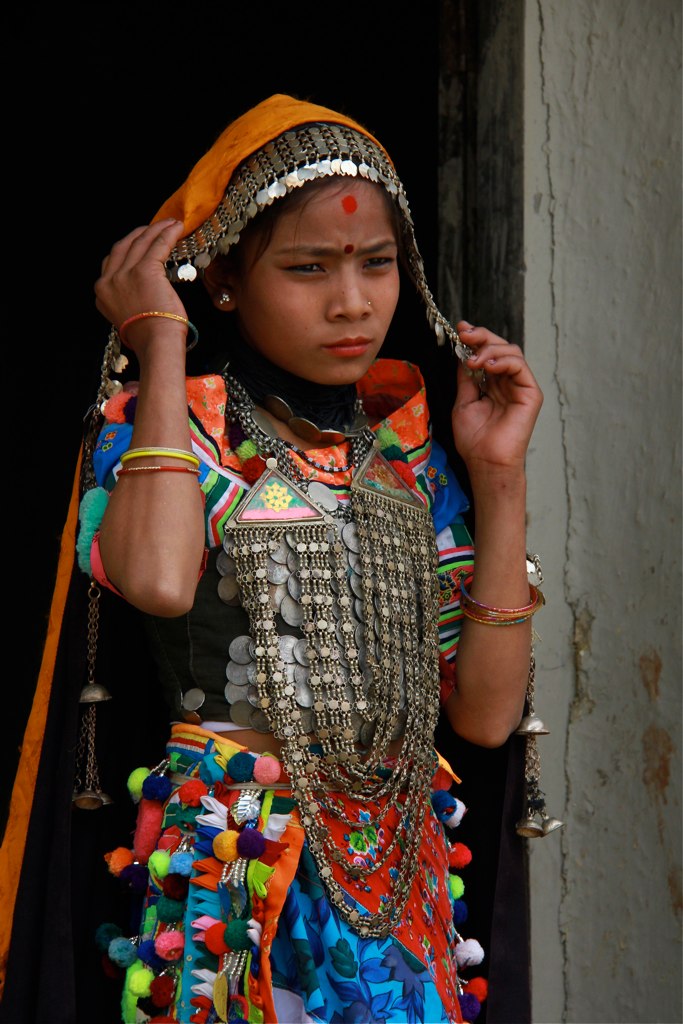
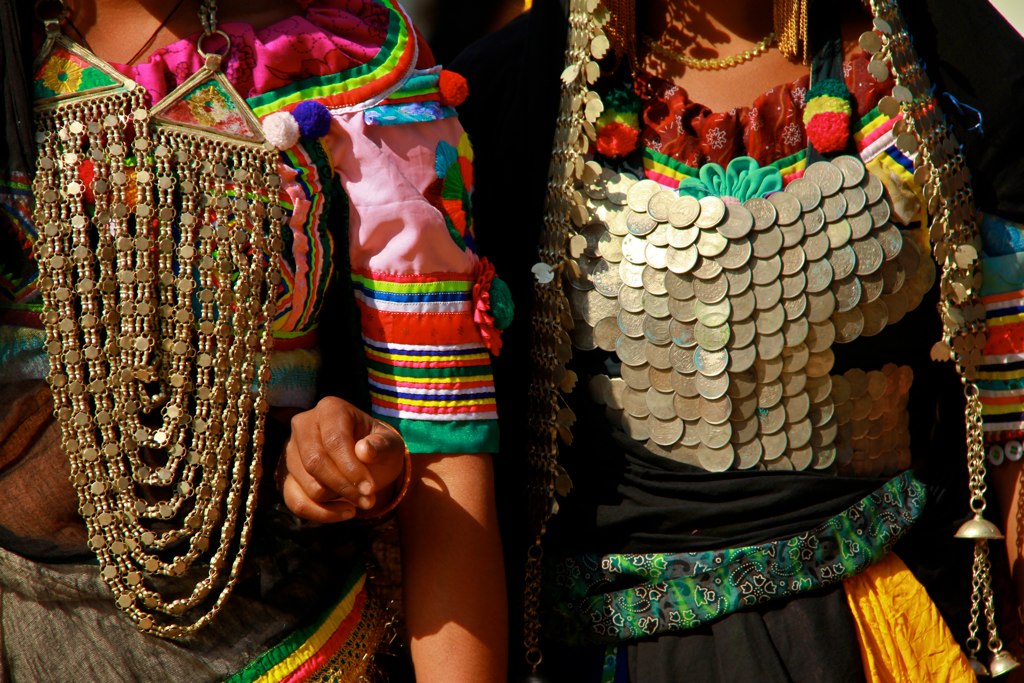
When people talk about Tharu dress and ornaments, they usually mean the women — because the tradition of Tharu ornaments is most fully expressed by Tharu women, from head to foot, and every part of the body has its own vocabulary of jewelry.
On the forehead and head: Kilipha, Kanta, Phulara Choti, Maniya, Senura, Tikuli, Dhari, and Tikka.
On the nose: Phophi, Phuliya, Nathiya, Nathuni, Nasaa, and Khila — worn specifically on the left side of the nose.
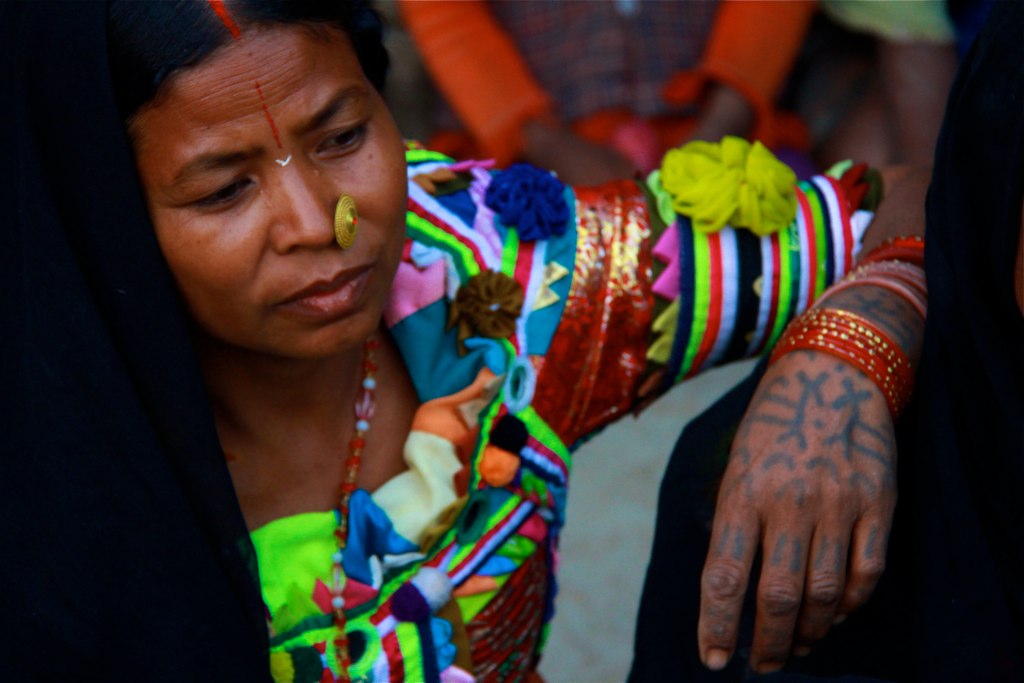
On the ears: Taraki, Sikadi, Sidhari, Lari, Tappa, Jhumka, Laheka, Tarki, Aerana, and Bichakani.
On the neck: Sutiya, Thumari, Rupayakamala, Chaukimala, Hara, Sitahara, Chandrahara, Sikadi, and Mudiyamala.
On the hands and arms: Baju, Churiya, Bahotta, Kanna, Tediya, Lahathi, Josana, Pahunchi, Agela, Pacchela, Chhaniya, Rupayaka, Bahulla, and Saloni.
That’s not a list padded for length. Each name is a real, distinct ornament with its own place and meaning. Tharu ornaments are not mixed and matched randomly — there’s a grammar to how they’re worn, one that Tharu women learn over time.
This tradition of Tharu dress and ornaments is one of the most detailed in Nepal’s Terai communities. And like most traditions, it’s changing. Younger women wear fewer pieces. Some items are now found only in museums or on older women during festivals.
Tharu Tattoo: The Ink That Goes with You
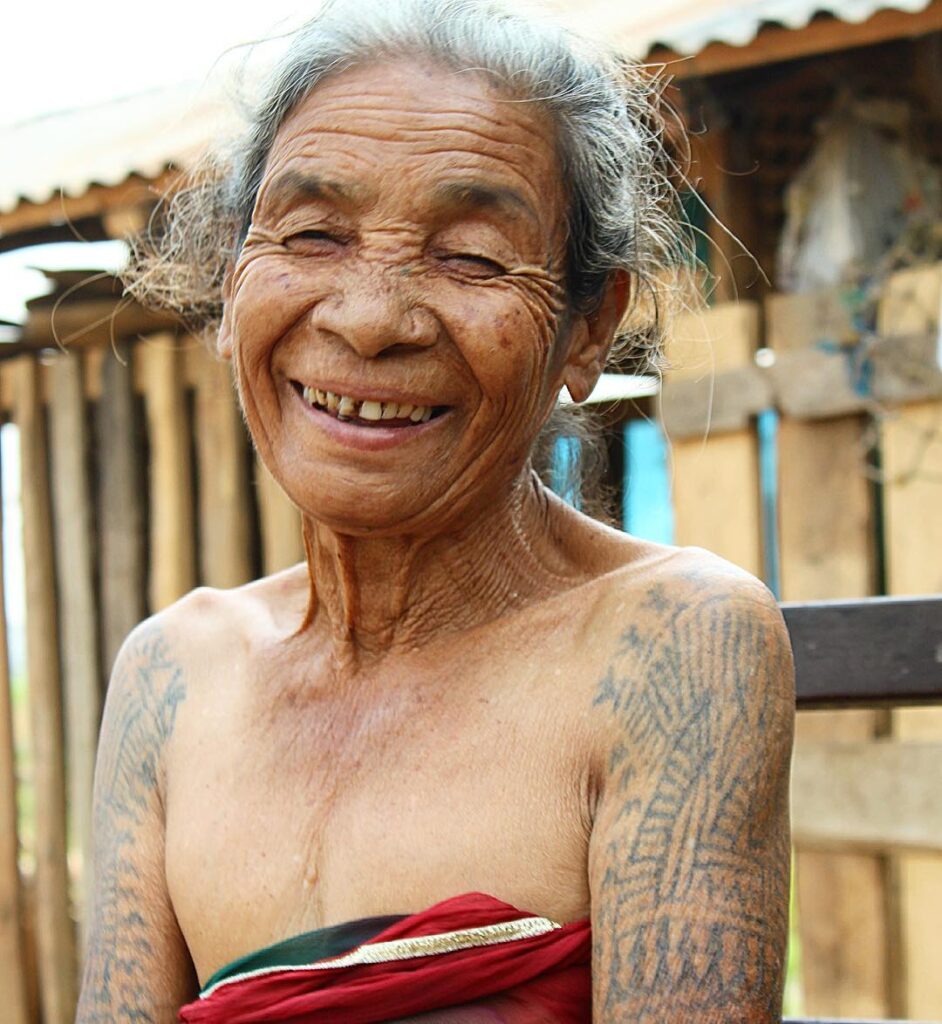
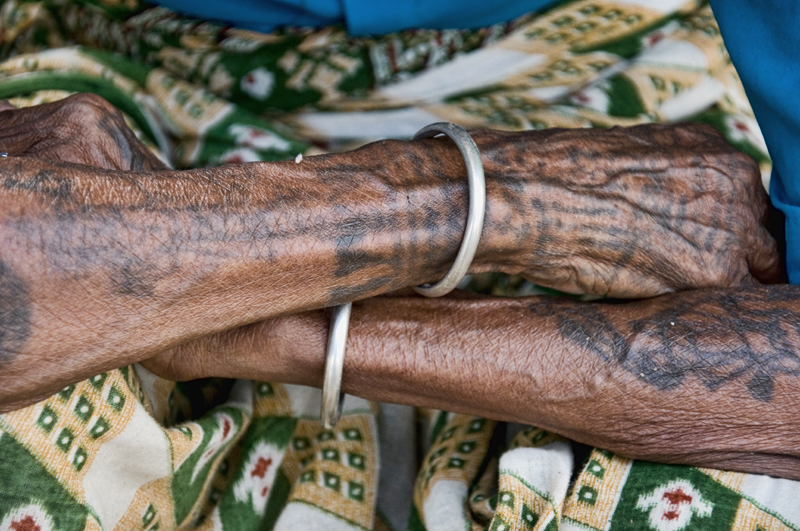
The Tharu tradition of tattooing is called “Khodna” or “Godana.” Women get tattooed on their hands, thighs, legs, chest, and backs. The tattoos are done by women tattooists called “Tikaniya” using sharp needles and black ink made from the soot of a mustard lamp. It’s painful enough that people sometimes faint during the process.
The designs come from nature — peacocks, a bird called Mejoor, lines, dots, crosses, and other elements from the world around them. Simple on the surface, but specific. Not decorative filler.
The beliefs behind Tharu tattoos are serious ones:
Tharu women believe the tattoos go with them to the next dimension after death. They’re considered personal property and gifts to the deceased. They also treat them as permanent jewelry — ornaments that can never be stolen, that stay on the body for life.
In earlier generations, Godana was something every married Tharu woman had. Today, among younger women, the practice is fading. You’ll mostly see these tattoos now on older women. Modernization didn’t preserve it, and that’s a real loss — not a polite cultural observation, but an actual disappearance of something that took centuries to develop.
The Tharu Cushion Cover: Bringing It Home
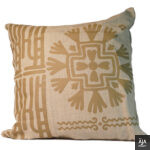
The Aja Dynasty Tharu cushion cover collection draws directly from Tharu tattoo art. The motifs on each cover are the same ones Tharu women carried on their skin — peacocks, Mejoor birds, geometric patterns from nature — translated onto fabric for your home.
It’s a small thing, but it’s intentional. When a tradition stops being practiced, the only way to keep it alive is to keep it visible. These cushion covers do that without turning the culture into a costume.
The collection comes in:
- 2 sizes to fit standard and larger cushions
- 4 designs — Tharu Cushion Cover 1, 2, 3, and 4 — each based on distinct tattoo motifs
For photos and full details of each design, visit the Aja Dynasty Shop section.
FAQs
What is Tharu art?
Tharu art is the visual tradition of Nepal’s indigenous Tharu community, primarily from the Terai region. It includes wall paintings, woodcarving, pottery, and tattooing — all deeply tied to nature. Common motifs include elephants, peacocks, fish, snakes, and flowering plants.
What are Tharu ornaments?
Tharu ornaments are a layered system of jewelry worn by Tharu women across the head, nose, ears, neck, and hands. Each piece has a specific name and place. Examples include Tikuli on the forehead, Nathiya on the nose, Jhumka on the ears, and Churiya on the wrists.
What is Tharu tattoo called?
The traditional Tharu tattoo is called “Khodna” or “Godana.” It’s applied by women tattooists called Tikaniya, using needles and ink made from mustard lamp soot. Designs come from nature — birds, geometric patterns, plants.
What inspired the Tharu cushion cover designs?
The Aja Dynasty Tharu cushion covers are based on traditional Tharu tattoo motifs. The same designs that Tharu women wore on their bodies — peacocks, the Mejoor bird, geometric patterns — appear on the cushion covers.
Where do the Tharu people live?
Tharu people live across Nepal’s Terai belt and in parts of northern India adjacent to Nepal. Major subgroups include Rana Tharu and Kathariya Tharu in Kailali and Kanchanpur, Dangaura Tharu in western Terai, Chitwan Tharu in central Nepal, and Kochila and Danuwar Tharu in eastern Terai.
How many designs does the Tharu cushion cover come in?
The Aja Dynasty Tharu cushion cover comes in 4 designs (Tharu Cushion Cover 1, 2, 3, and 4) and 2 sizes. Full photos and details are available in the Aja Dynasty Shop.
Related reading: Aja Dynasty Cushion Cover Collection || Tharu : And Ancient Tattoo Artist
Source: Tharu community documentation; Aja Dynasty product research; Al-Biruni historical records on Tharu presence in eastern Terai



Get the Latest
Subscribe Now
Sign up for Aja Dynasty emails to be the first to see inspiring content, news, new product announcements and exclusive offers.
Rewards